

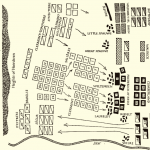
The Battle of Lauffeldt 1747
Introduction Following its role in supressing the Jacobite rising, the 36th Regiment of Foot (at that time known as Flemming’s Regiment) was posted to the continent, as part of the army of Duke of Cumberland, who was now campaigning in the Europe. Here, Flemming’s were involved in numerous minor actions but its most notable engagement […]

The Siege of Barcelona 14 September to 19 October 1705
This siege took place during the War of the Spanish Succession when a Grand Alliance army led by Lord Peterborough, supporting the Habsburg claimant to the Spanish throne, captured the city of Barcelona from its Spanish Bourbon defenders. Catalonia was regarded as of strategic importance and a potential source of military support for the Allies […]
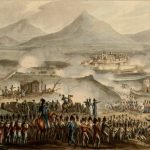
The Battle of Toulouse 10th April 1814
With Soult moving east, Wellington sent Beresford and two divisions to seize Bordeaux, the third-largest city of France. To make up for this Wellington summoned 8000 Spanish infantry and the British heavy cavalry as reinforcements. Meanwhile, the British-Portuguese-Spanish army pushed the French out of Aire-sur-l’Adour on 2 March in a skirmish. Soult pulled back to […]
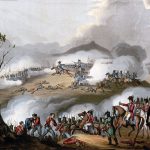
The Battle of Orthez 27th February 1814
On the morning of February 23rd 1814 the left wing of the Allied army under Sir John Hope began its daring crossing of the Adour to the west of the town of Bayonne. The Guards, supported by riflemen of the 5/60th, crossed the river in small groups, ferried across the river on rafts. By the […]
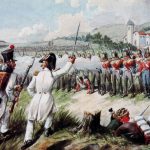
The Battle of Vimeiro 21 August 1808
After the Battle of Roliça, General Sir Arthur Wellesley established a position near Vimeiro to cover a beachhead at Maceira Bay. Most of ,his reinforcements had arrived by 20 August and Wellesley planned to advance to Lisbon. His force consisted of eight independent infantry brigades, 17 cannons, 240 light cavalry and about 2,000 Portuguese troops […]
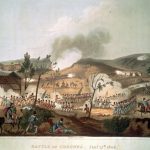
The Battle of Corunna 16th January 1809
In Spain known as Battle of Elviña, took place on 16 January 1809, when a French corps under Marshal Nicolas Soult attacked a British army under Lieutenant-General Sir John Moore. The battle was a result of a French campaign, led by Napoleon, which had defeated the Spanish armies and caused the British army to withdraw […]
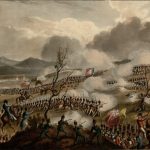
Battles of the Nive (9–13 December 1813)
After his defeat at Nivelles, Marshal Soult fell back to a defensive line south of the town of Bayonne along the Adour and Nive rivers. Despite poor weather, Hill led five Anglo-Portuguese divisions (2nd (including the 29th Regiment), 3rd, 6th (including the 36th Regiment), Portuguese and Pablo Morillo’s Spanish Divisions) across to the east bank […]
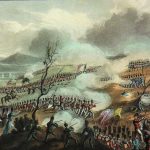
Battle of Nivelle 10 November 1813
Following the Allied victory at the siege of San Sebastian, Wellington’s 80,000 British, Portuguese and Spanish troops pursued the army of Marshal Soult into France. Soult took up a strong defensive position in front of the River Nivelle. At this point, the river’s course is marked by a series of hills on which the French […]

Centrepiece of the 36th Regiment.
Regimental Silver “…….. part of the tradition of service and martial pride which is the heritage of those to whom they belong. We are all brought up to regard them as symbols of great achievements of the glorious past…… These silver tokens are a constant reminder of the loyalty and deep sense of duty of […]
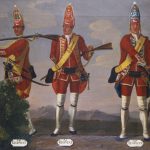
Battle of Culloden April 16th 1746
The battle of Culloden was the final pitched battle to take place on British soil. It was fought between the Jacobite army of Charles Edward Stuart (Bonnie Prince Charlie) and British Hanoverian government troops led by the Duke of Cumberland, son of King George II. Charles was the grandson of James II who was exiled […]