
Battle of Culloden April 16th 1746
The battle of Culloden was the final pitched battle to take place on British soil. It was fought between the Jacobite army of Charles Edward Stuart (Bonnie Prince Charlie) and British Hanoverian government troops led by the Duke of Cumberland, son of King George II.
Charles was the grandson of James II who was exiled following the “Glorious Revolution” of 1688 which replaced the Stuart dynasty with his daughter Mary II and his Dutch nephew and Mary’s husband, William III of Orange.
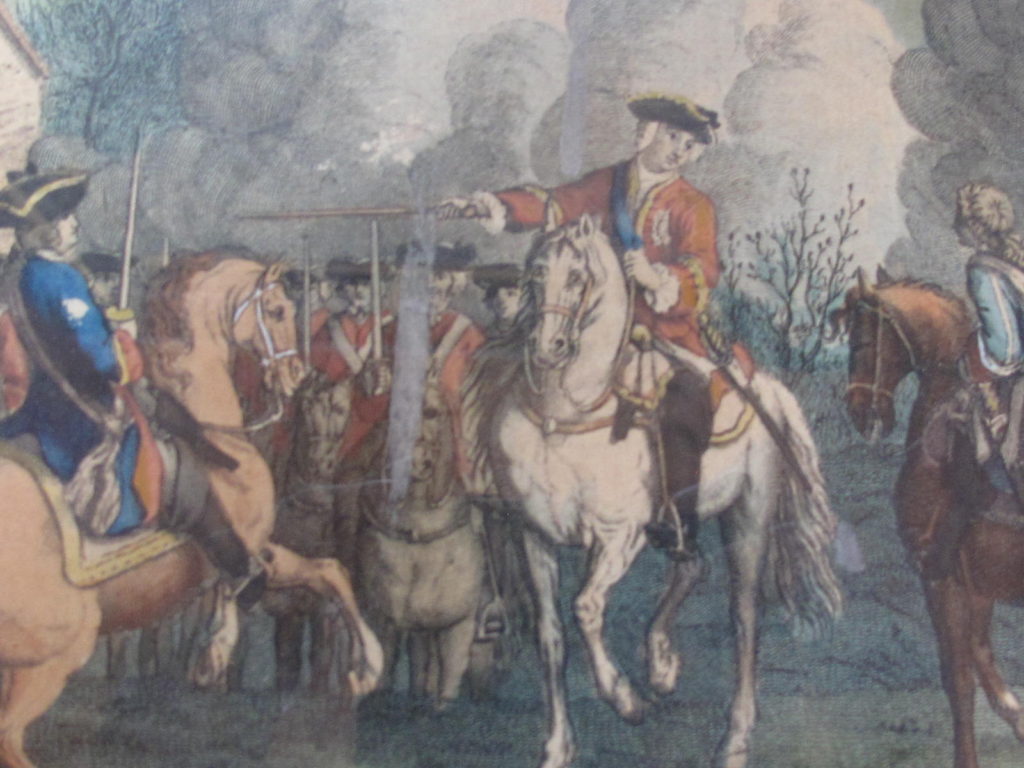
Believing there was support for a Stuart restoration in both Scotland and England, Charles landed in Scotland on July 1745 raising an army of Scots Jacobite supporters. The Jacobite campaign to restore the Stewart dynasty began with reasonable success, with support from the Scottish Charles Edward’s highland army defeated government troops at Prestonpans in September 1745 and was able to occupy Edinburgh reaching as far south as Derby but failing to gain English support forced them to retreat to Scottish territory in December 1745. The following year despite being on the defensive Charles’s army gained an impressive victory of the government army at Battle of Falkirk won in January 1746.
After the defeat of General Hawley at Falkirk, William Augustus (Duke of Cumberland) was appointed as commander of the government forces in Scotland and based his army in Aberdeen, setting out in April 1746 to engage with Charles’s troops who were located at Inverness.
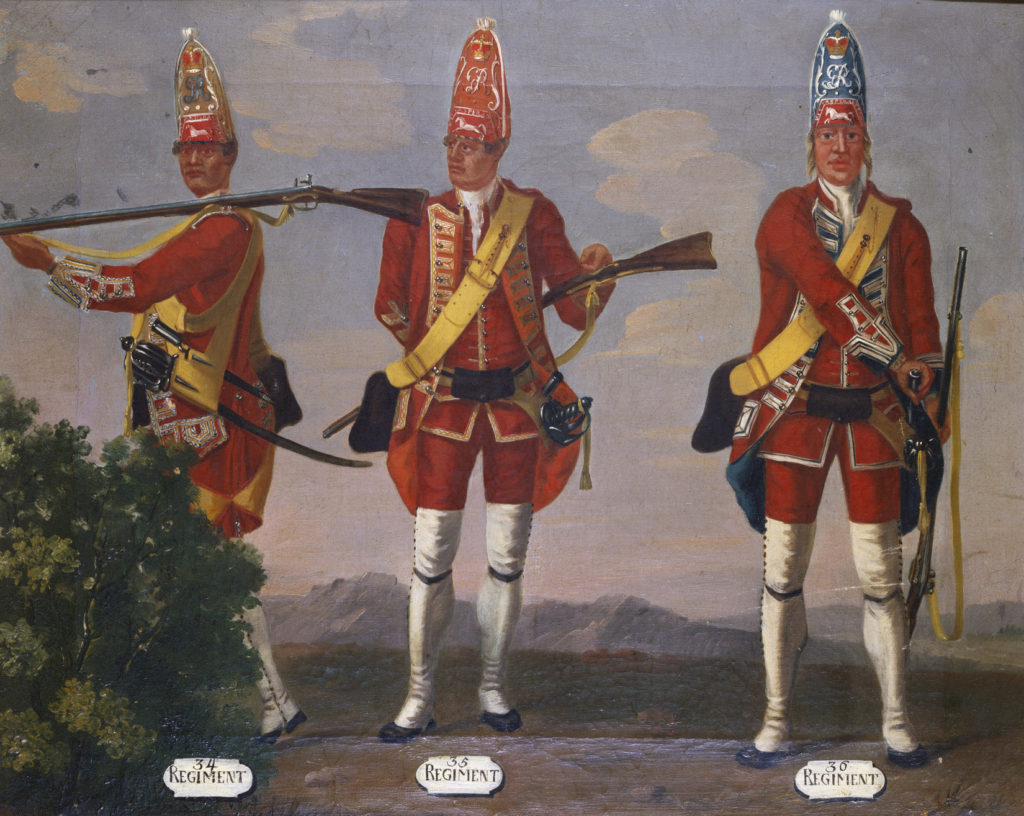
The two armies eventually met at Culloden with Charles Stuart’s army consisting of 5,000 men – largely formed of Scottish clansmen and 8000 government forces made up of 17 regiments including the 36th Regiment of Foot commanded by Colonel Flemming.
The day prior to the battle the Duke of Cumberland’s celebrated his birthday at Nain during which the Jacobite’s attempted a night attack on Cumberland’s camp, however this ended in complete failure with soldiers falling far behind and losing themselves in the bog and with dawn close to breaking it was clear the Jacobite forces would not reach Nairn before daylight resulting in the exhausted Scottish clansmen returning back, tired and exhausted, to their former positions on Drummossie Moor. Two hours after they had arrived, they heard news that the British army was on the march and only four miles away. The Highlanders dragged themselves to their feet and formed a line.
What followed was a gruesome and bloody one- hour battle with a swift and decisive victory by Cumberland and the government troops. Charles began the battle on the defensive expecting Cumberland to attack, instead the Cumberland’s forces remained stationary using cannons to bombard the Jacobite forces inflicting casualties on the highlanders and wreaking havoc on their morale.
Following the bombardment Charles ordered his troops to charge the enemy lines – a tactic which had proved very effective in their previous engagements.
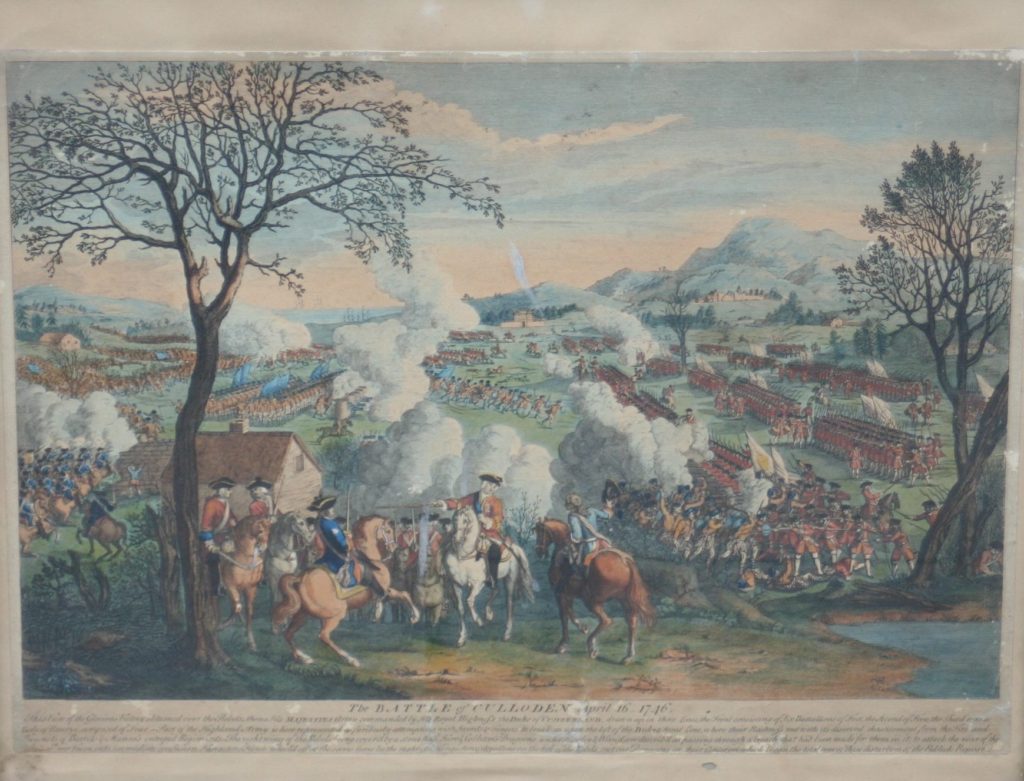
Cumberland’s secretary, Everard Fawkener describes the charge in a letter in which he writes…
“The rebels then charged towards our right wing, waving their swords in the air and shouting: they hoped to tempt our right wing to leave the battle line and attack them. But His Royal Highness, the Duke of Cumberland, commanded these troops himself and they kept to their line. The rebels then made a mass attack on our left wing: they ran forward, sometimes stopping to fire their pistols and muskets and reload. They were met with fierce musket fire from the British and were almost cut to pieces by our cannon. The whole weight of the rebel attack fell on two battalions of the British left – the Scots Fusiliers and Munro’s. It seemed that the rebels would get round the left wing, but Colonel Wolfe moved up his battalion to stop this. Here the bayonets of the British caused great slaughter of the rebels.
The rebel charge failed, and their army fell back. On the left, the British cavalry rode through gaps which had been made in a stone wall and attacked the rebel right wing which was put to flight with its reserve. The cavalry on the British right also rode round the rebel wing and attacked the enemy from behind. At this, the rebel army fled. The British infantry advanced and gained ground where the rebels had stood. There our men gave three cheers”
By the end of the battle the Charles Stuart had lost between 1000- 1500 men out of his original 5000 strong force in comparison to Cumberland’s forces only suffering 50 dead and another 259 wounded. Charles himself was able to escape the battlefield and, after many adventures, reached France but campaign for a Stuart Monarchy would never happen again.
The 36th Regiment of Foot suffered only 6 wounded soldiers having seen very little action during the battle being placed in the second line as the 4th of 7 regiments in formation.
Officer’s of the 36th who took part at the Battle of Culloden
Below are the names of the officers who formed the 36th Regiment and took part at the battle of Culloden.
ACKLAND DUDLEY – Lieutenant
ARNOTT WILLIAM – Captain
BROWN ROBERT – Major
BUCKSTON THOMAS – Captain
CHAMIER ROBERT – Captain
CARLETON HUMPHREY – Ensign
DENNY WILLIAM – Captain
DODD GILBERT- Captain
DUDLEY WILLIAM – Lieutenant
DUNCAN ALEXANDER – Ensign
ELRINGTON THOMAS – Ensign
GORE HENRY- Captain/ Lieutenant
HAMILTON ROBERT – Ensign
JACKSON GEORGE – Lieutenant colonel
MATTHEWS JOHN – Ensign
MOREAU PAUL – Ensign
MONTGOMERIE ARCHIBALD 11th EARL OF EGLINTON – Captain
NAPPER (NAPIER) ANDREW – Lieutenant/ Adjutant?
POTTER GEORGE – Ensign
PRICE JOHN – Ensign
REMINGTON GERVAS (JERVAIS) – Captain
RICE JOHN – Ensign (Volunteer)
ROBINSON WILLIAM – Lieutenant/ Adjutant
SKENE (SHEYNE SKEYNE) GEORGE – Ensign
STRONGE BLACHFORD – Ensign
VAUGHAN HENRY – Ensign
VEALE SAMUEL BUCK – Lieutenant
People Facet Tree