

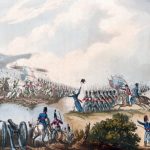
The Battle of Albuera 16 May 1811
From October 1810 Marshal Masséna’s Army of Portugal had been forced into an increasingly hopeless stand-off against Wellington’s Allied forces, behind the Lines of Torres Vedras. In early 1811 Marshal Soult led a French expedition from Andalusia into Extremadura in a bid to draw Allied forces away from the Lines and relieve Masséna. However, Masséna’s […]
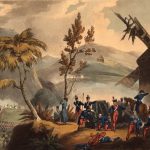
The Battle of Roliça, 17 August 1808
On 23rd July 1808, General Arthur Wellesley received a dispatch from Viscount Castlereagh, the Secretary of War, informing him that the French General Junot’s forces in Portugal now numbered more than 25,000. Castlereagh explained his plans to re-inforce the British army in Portugal with 15,000 men. General Sir John Moore was to proceed with an […]
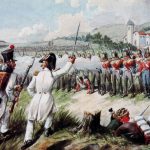
The Battle of Vimeiro 21 August 1808
After the Battle of Roliça, General Sir Arthur Wellesley established a position near Vimeiro to cover a beachhead at Maceira Bay. Most of ,his reinforcements had arrived by 20 August and Wellesley planned to advance to Lisbon. His force consisted of eight independent infantry brigades, 17 cannons, 240 light cavalry and about 2,000 Portuguese troops […]
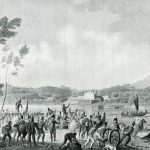
Crossing of the Douro 12th May 1809
Also known as the Battle of the Douro or the Second Battle of Porto, was a battle in which General Arthur Wellesley’s Anglo-Portuguese Army defeated Marshal Nicolas Soult’s French troops and took back the city of Porto. After taking command of the British troops in Portugal on 22 April, Wellesley (later named 1st Duke of […]
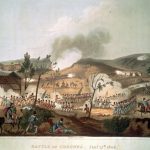
The Battle of Corunna 16th January 1809
In Spain known as Battle of Elviña, took place on 16 January 1809, when a French corps under Marshal Nicolas Soult attacked a British army under Lieutenant-General Sir John Moore. The battle was a result of a French campaign, led by Napoleon, which had defeated the Spanish armies and caused the British army to withdraw […]
Some Worcestershire Regiment Footballing Heroes
“Inter-war sport was marked by competition with foreign teams, but such interaction also illustrated problems with the British focus on amateurism. By the 1930s, Belgian and French teams were far superior to British counterparts because these armies encouraged sporting development along professional lines. Both the Belgian and French armies, which enforced conscription, found their countries’ […]
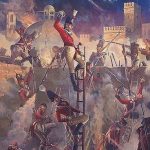
The Siege of Badajoz 1812
On March 16th 1812 a British Force some 15,000 strong with a battering train of 52 guns reached Badajoz, a strongly fortified Spanish town near the frontier with Portugal. General of Brigade Philippon commanded in Badajoz with a force of 4,742 men and although short of powder and shell, still presented a formidable task to […]
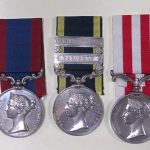
Important Acquisition – the medals of Major F. Kneebone
With the generous assistance of the The ACE/V&A Purchase Grant Fund and the Friends of the Mercian Regiment Museum we have recently acquired a group of three medals awarded to Major. Frederick Kneebone of the 29th Foot. These comprise medals awarded for his service in India and consist of the Sutlej medal 1845-6 for Sobraon (ensign), […]
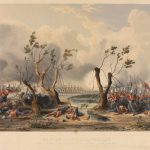
The Battle of Chillianwallah 13th January 1849
Fought during the Second Anglo-Sikh War, in the region of Punjab, now part of Pakistan. Although the battle may be considered a draw, it was a strategic check to Britain, and damaged British prestige in India. When war broke out in the Punjab, which had recently lost much of its independence to the British East […]
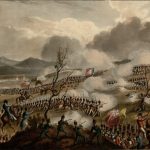
Battles of the Nive (9–13 December 1813)
After his defeat at Nivelles, Marshal Soult fell back to a defensive line south of the town of Bayonne along the Adour and Nive rivers. Despite poor weather, Hill led five Anglo-Portuguese divisions (2nd (including the 29th Regiment), 3rd, 6th (including the 36th Regiment), Portuguese and Pablo Morillo’s Spanish Divisions) across to the east bank […]
People Facet Tree