

Work Experience: Cataloguing James Batchelor
For this past week, I have worked within the museum for my year twelve work experience; it has certainly been an incredible opportunity to learn more about my local regiment, as well as the ways in which a museum operates. Below, is the information regarding Captain and Quartermaster James Batchelor, D.C.M. which I have collated via the medals and documents received by the Regimental museum at auction, alongside information of the Battalions’ history through the museum’s archives. I would like to thank the financial contributors for their assistance in obtaining these objects – these are mentioned below – as well as the hard work of Andrew Udall in his compiling of the history of Batchelor in his writings and presentation and preservation of his documents.
In July of 1874 within the depths of Selly Oak, Birmingham, James Batchelor was born to Harriet and James Batchelor; this family would expand to include his siblings Charles, Emma, Harriet, William, and Ellen. During his early life, Batchelor found himself within the trade of copper tube drawing until his enlistment into the Worcestershire Regiment on the 13th September 1892 at the age of 18, remaining in his family home in Bournebrook, Birmingham. From this, Batchelor was given his army number of 3339 and, thus, posted to Curragh Camp in Ireland to join the 2nd Battalion until November 1893, marking the beginning of his military career.
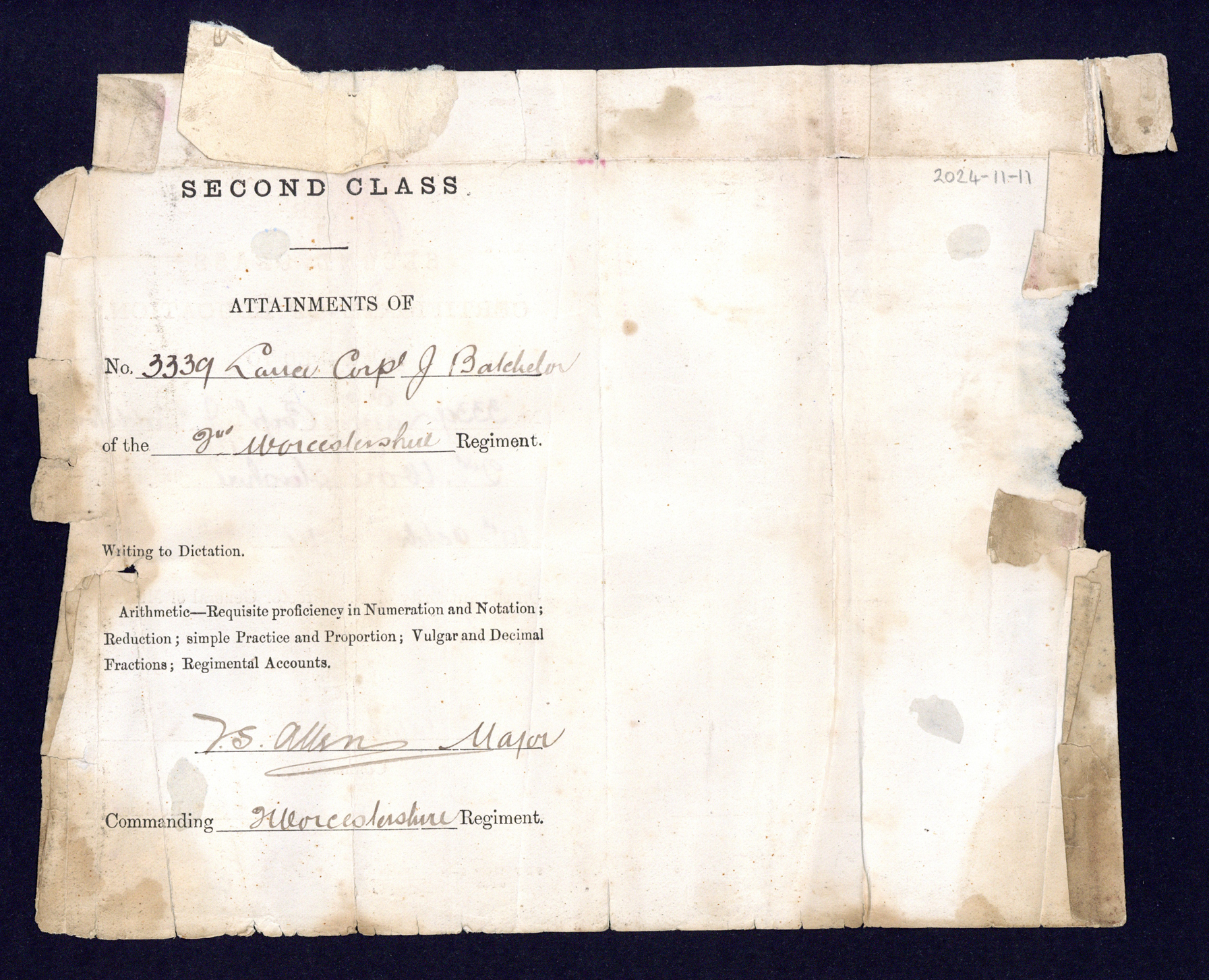
Batchelor’s military life was propelled forward following his Battalion’s move to Aldershot, arriving on the 11th November 1893, during which he began to further improve his education in order to allow for promotion, earning his first Good Conduct Pay and Badge on the 13th September 1894 and was promptly promoted to Lance Corporal on the 16th October. Batchelor was keenly dedicated to his studies throughout this period, earning his 2nd Class Certificate of Education on 19th October suggesting great proficiency in the subjects of literacy and mathematics.
This was soon followed by another promotion to Corporal in January 1895.
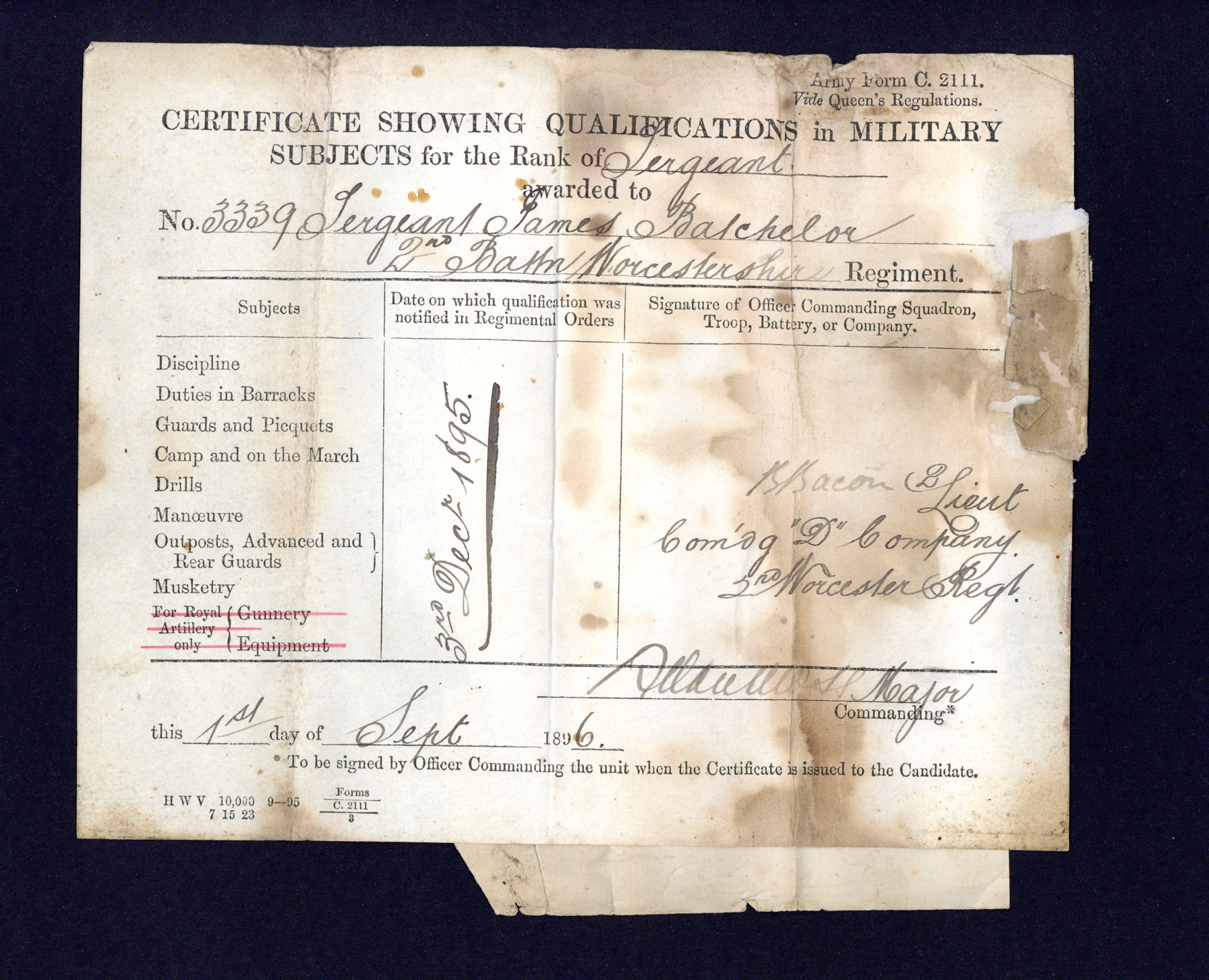
Batchelor’s first real experience of foreign shores came with a posting with his Battalion to Malta on 14th November 1895, coinciding with his further promotion to the rank of Lance Sergeant. Once again keen to advance himself further within the ranks, Batchelor studied for promotion to Sergeant, testing disciplines such as drills, outposts, and musketry. Successful in such, Batchelor’s examination pass was published in Regimental Orders on 3rd December 1895.
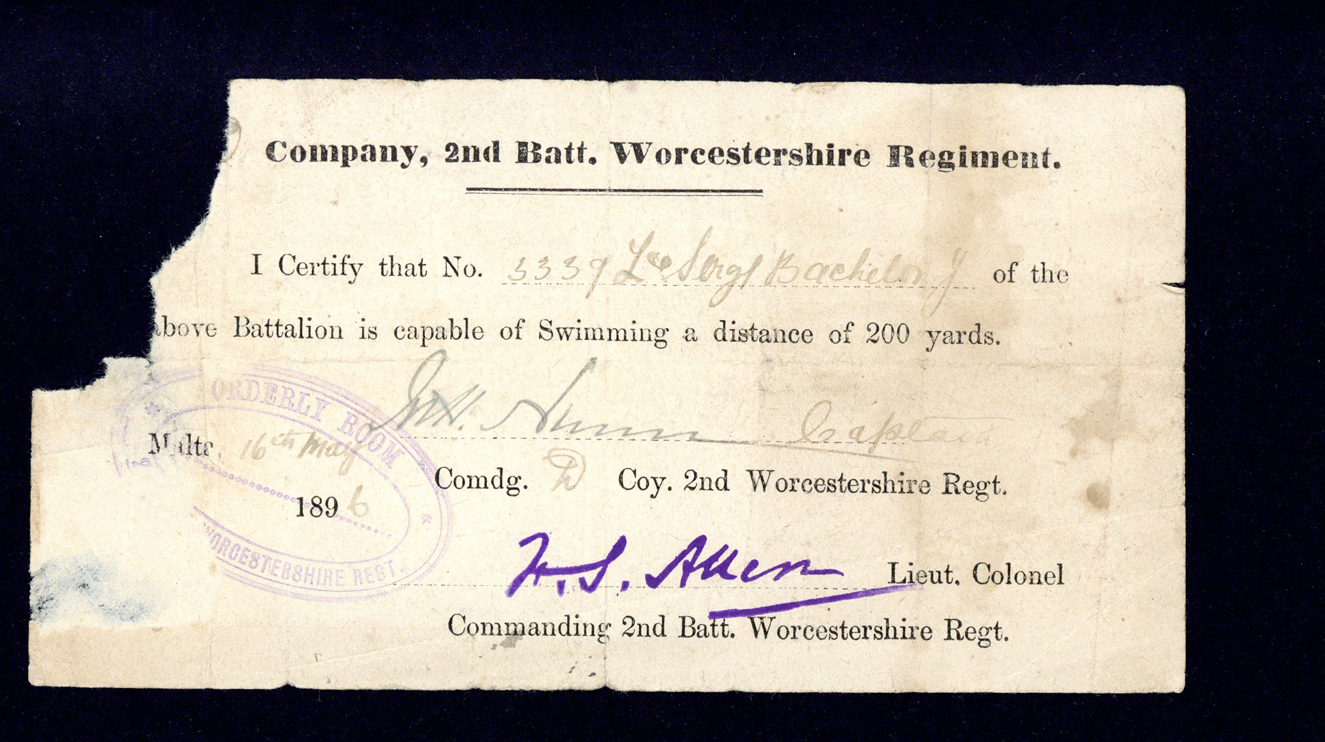
Additionally, whilst in Malta, Batchelor presented his interdisciplinary skill in his competency in swimming, examined as being able to swim 200 yards on the 16th May 1896, as shown by the certificate below.
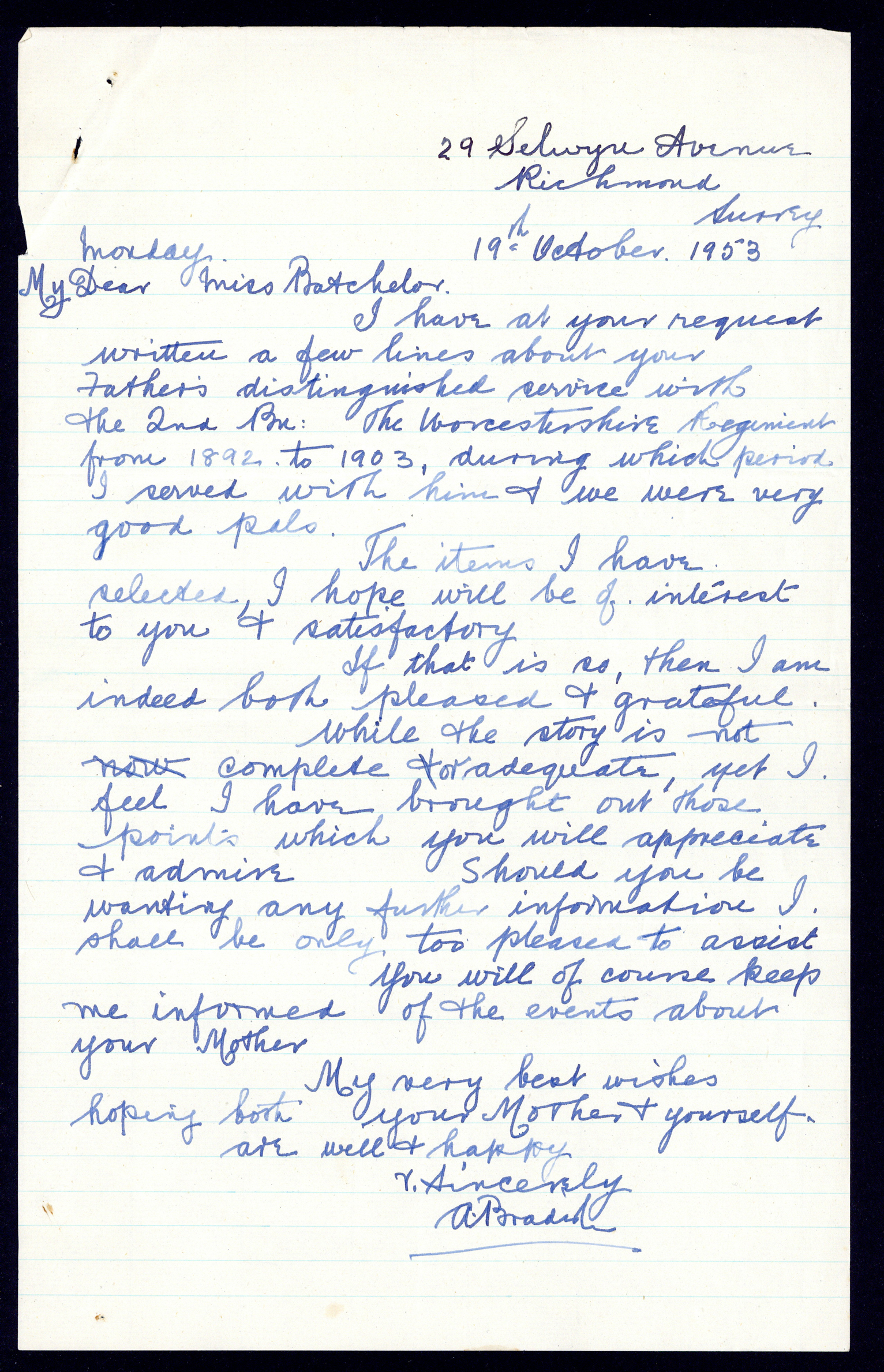
This new swimming qualification was put to great use in Malta during an incident involving the Regiment Sergeant Major, John Ryder. In a letter to the late Batchelor’s daughter, his former friend and fellow soldier, Captain Bradish, recounted the event, recording: “The Sergeant’s boat was out one evening with eight oars and the tiller. The Sergeant Major, John Ryder, and Jim (Batchelor) were of the crew. It was the custom to bathe from the boat. The S.M. was soon in difficulties – he went down once – twice and then Jim leapt from the boat and caught hold of the S.M. and with help, hauled him abroad”. It, thus, becomes apparent how vital of an asset Batchelor was to his Battalion; Sergeant Major Ryder would, henceforth, live to the age of 91, placing him as the oldest soldier of the regiment.
The following few years of Batchelor’s military career were a period marked by much fast-paced travel. The 3rd of October 1897 saw the Battalion embark from Malta to Bermuda, where Batchelor would earn his second Good Conduct Pay and Badge, for the next two years until their return to the United Kingdom in October of 1899. During this chapter, the Boer War was well underway, though, the contemporary view of this colonial war had been significantly undercut, as the Boers had proved themselves to be foe more threatening than the British Army had previously conceived.
Such called for the arrival of the 2nd Battalion from Southampton to South Africa on the 17th of December 1899, forming part of the 12th Infantry Brigade under Brigadier General Clement and part of the 6th Division under Lt. General Kelly-Kenny, C.B.
Here, Batchelor would be promoted to the rank of Colour sergeant in on the 2nd of February 1900.
Remaining within Cape Colony, the Battalion occupied a vulnerable position on the extreme right flank of the British line and were subjected to fatal shelling by the Boers. This campaign provided Batchelor with the opportunity to prove himself as an incredibly capable leader in his Battalion; on the 9th of February 1900, Batchelor valorously led a patrol of 6 men whilst on outpost duty in the hills, managing to capture two Boers – the first prisoners of the Brigade. Following interrogation, the Boers revealed that a Boer attack was imminent on the Battalion’s position, though final approval was supposedly being sought from Boer commanders at Bloemfontein. In a series of calculated conjectures, Batchelor concluded that the Boer attack would surely arrive on Monday the 12th – he was soon proved correct. This work, alongside his heroic contributions in the Battalion’s capturing of the Boer’s position in the Kopjes, cumulatively led to the recording of such gallantry by the Commander-in-Chief, Lord Kitchener, in his despatch dated 8th March 1901, which would later be published in the London Gazette in May of that year.
Military action continued throughout the rest of that year and into January of 1901, where on the 23rd, the Battalion marched around eleven miles through a defile until they reached Middlefontein whereupon they established camp, being surrounded by small kopjes on which were placed picquets as a guard against the Boers. However, trouble would soon emerge upon the falling of night, as the enemy had moved nearer in increasing numbers and by dawn, had completely surrounded the camp. The picquets on the nearest kopjes were rushed by the Boers and it had to be retaken – it was here that Batchelor came to prominent notice again. With Lt. E.B. Hankey wounded, Batchelor, with his half company of men, began to retake the position, leading his men “with boldness and gallantry and firing and cheering” until the post was “safely in (their) hands again”, as per the letter written by Captain Bradish, 1953.
For such valour, Batchelor was again officially mentioned in Earl Roberts’ despatch on 2nd April 1901, being published in the London Gazette in September 1901; he was, too, recommended for the Distinguished Conduct Medal for the gallantry presented. The award of D.C.M. would be officially recorded in the London Gazette on the 27th of September 1901.
Following such, Bachelor would begin on his venture back to the home front, arriving in Southampton on the 11th of February 1902. Here, Batchelor’s military prowess would be utilised in his assistance of training the new recruits and militia men who were being posted in the newly created 3rd and 4th Battalions. His time in England fell short upon his return to South Africa, arriving on the 7th of January 1903.
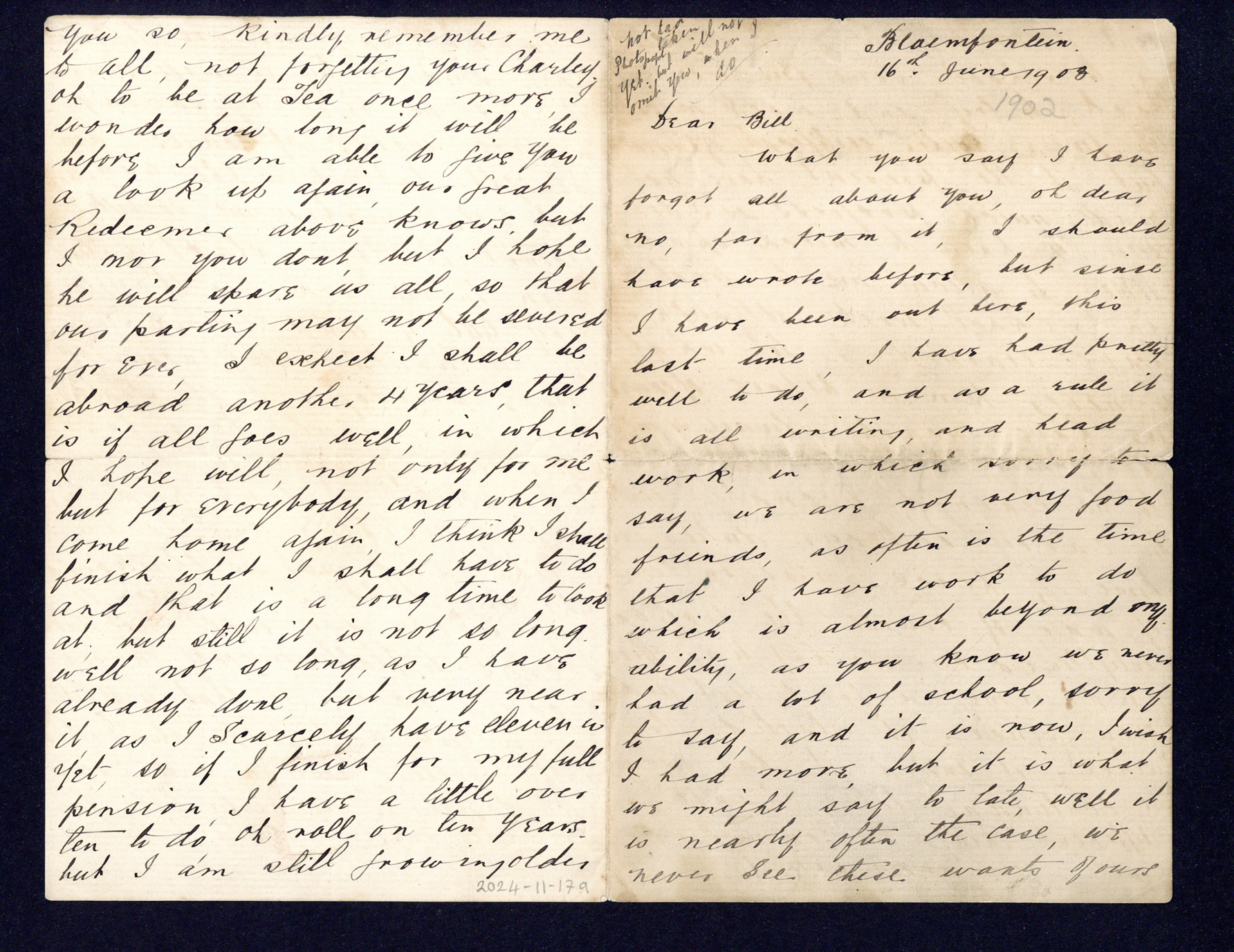
Here, whilst in Bloemfontein, Bachelor sent a hand-written letter to his brother William, dated the 16th of June 1903. Within this, you can observe his recording of his developments in education, some rather pessimistic accounts of the lack of progress in the war – “I expect it will be years before the difference will be noticed” – as well as mentions of religious practices and some detailing of life within the army.
Batchelor’s education within his field continued to develop following his return from South Africa, becoming qualified as an instructor of musketry in September of 1904, and at the Royal Small Arms, Sparkbrook, Birmingham on the 16th of March 1905, was certified in a weaponry course. The time spent by Batchelor on the home front would also allow for his courting and marriage of his wife, Minnie Batchelor, on the 26th of December 1904 in Handsworth, Birmingham.
Batchelor would thereafter remain with his Battalion until 1908, during which period he was promoted to Sergeant Major, and was then transferred to the Stourport Company of the 7th Territorial Battalion as Sergeant-Instructor. Batchelor proved himself as an incredibly efficient instructor as, under his leadership, within two years the company became the strongest in the Battalion; his skills being recognised, he would then be transferred to the headquarters of the Battalion based in The Shrubbery, Kidderminster.
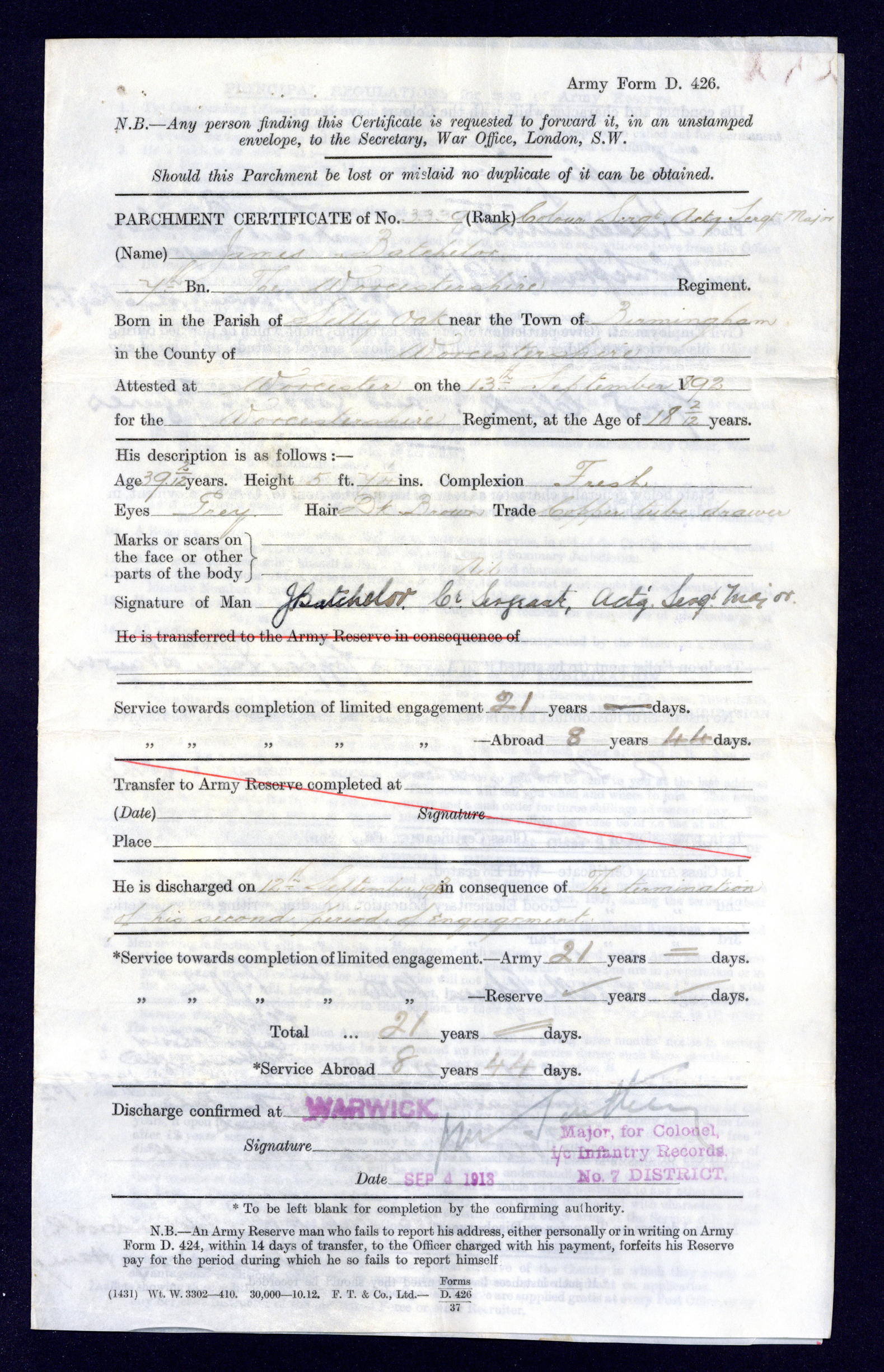
Batchelor would remain here until his retirement at the age of 39 on the 21st September 1913, having served 21 years.
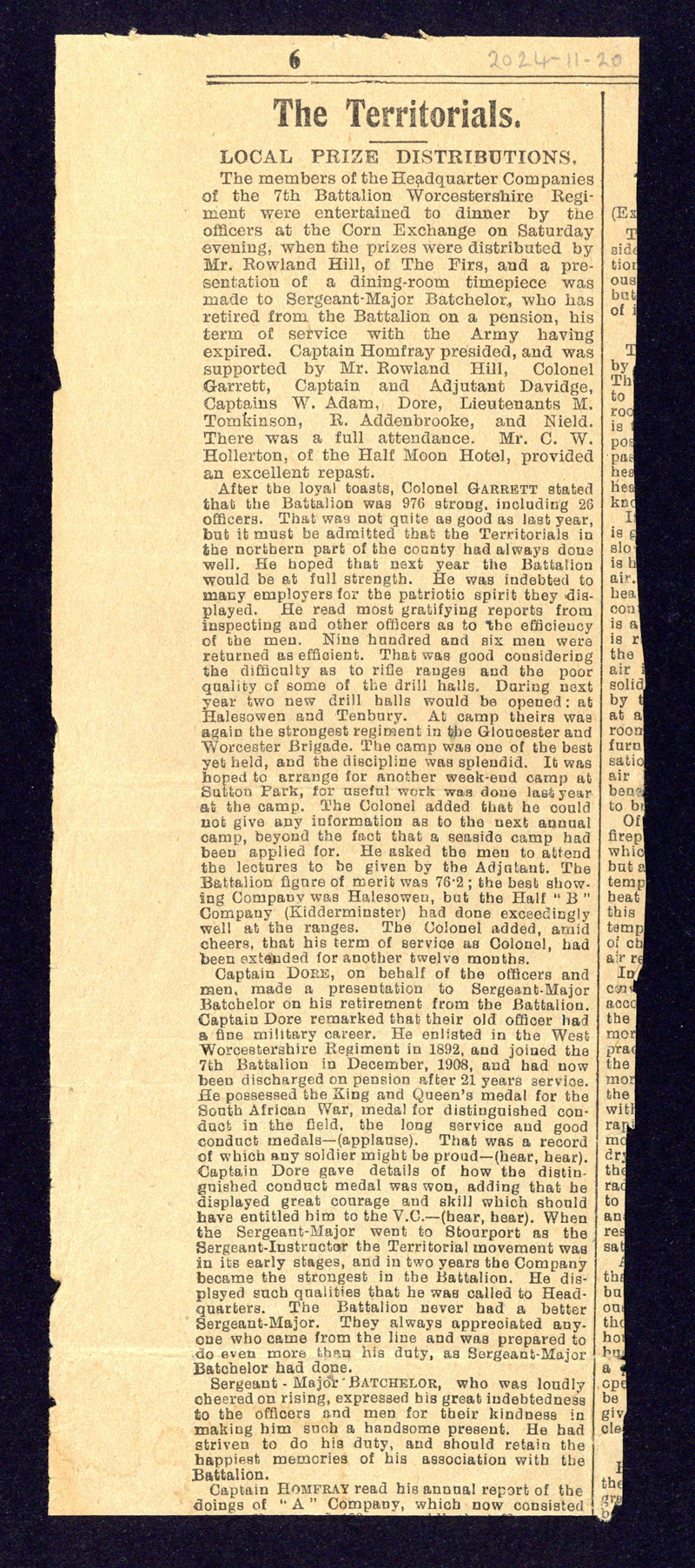
At the time of his retirement, members of the Headquarter Companies of the 7th Battalion were entertained to dinner at the Corn Exchange, Worcester, presided over by Captain Homfray. During the prize giving, Captain Dore presented Batchelor with a black marble cased clock to commemorate his retirement, and in a speech outlining his career and medals earned, Dore declared that Batchelor had “displayed great courage and skill which should have entitled him to the V.C.”, whereupon his comrades would cheer their support for the statement with “Hear, Hear!”. See below a press cutting of ‘The Territorials’ section of the local newspaper.
Retirement would play out to be a short-lived experience by Batchelor, as within a year of his return he was met for a call to arms upon the outbreak of the First World War, with his prior skills and abilities recognised greatly as he was commissioned Lieutenant and Quartermaster on the 21st July 1915 to the newly formed 14th Battalion of the Worcestershire Regiment on its formation on the 10th September, 1915.
As the Severn Valley Pioneers, this Battalion was proved to contribute heavily to logistics, spending three months reinforcing the defences of Bois de la Haie until their transfer to the Somme in October 1916 whereupon they faced intense labour within the defence works. The Battalion continued to remain in this area, often working under heavy shell fire, erecting important wire entanglements in February of 1916 in front of the captured German trenches. Work continued to further consolidate their new position over the next month, under continually relentless shell fire. Following the Battalion’s contributions to capture and defend Gavrelle in Arras in April of 1917, the Battalion sent out working parties to repair roads and defences until the sudden orders on the 24th of September 1917 to move northwards towards Ypres, in which the Battalion suffered further under extremely gruelling working conditions.
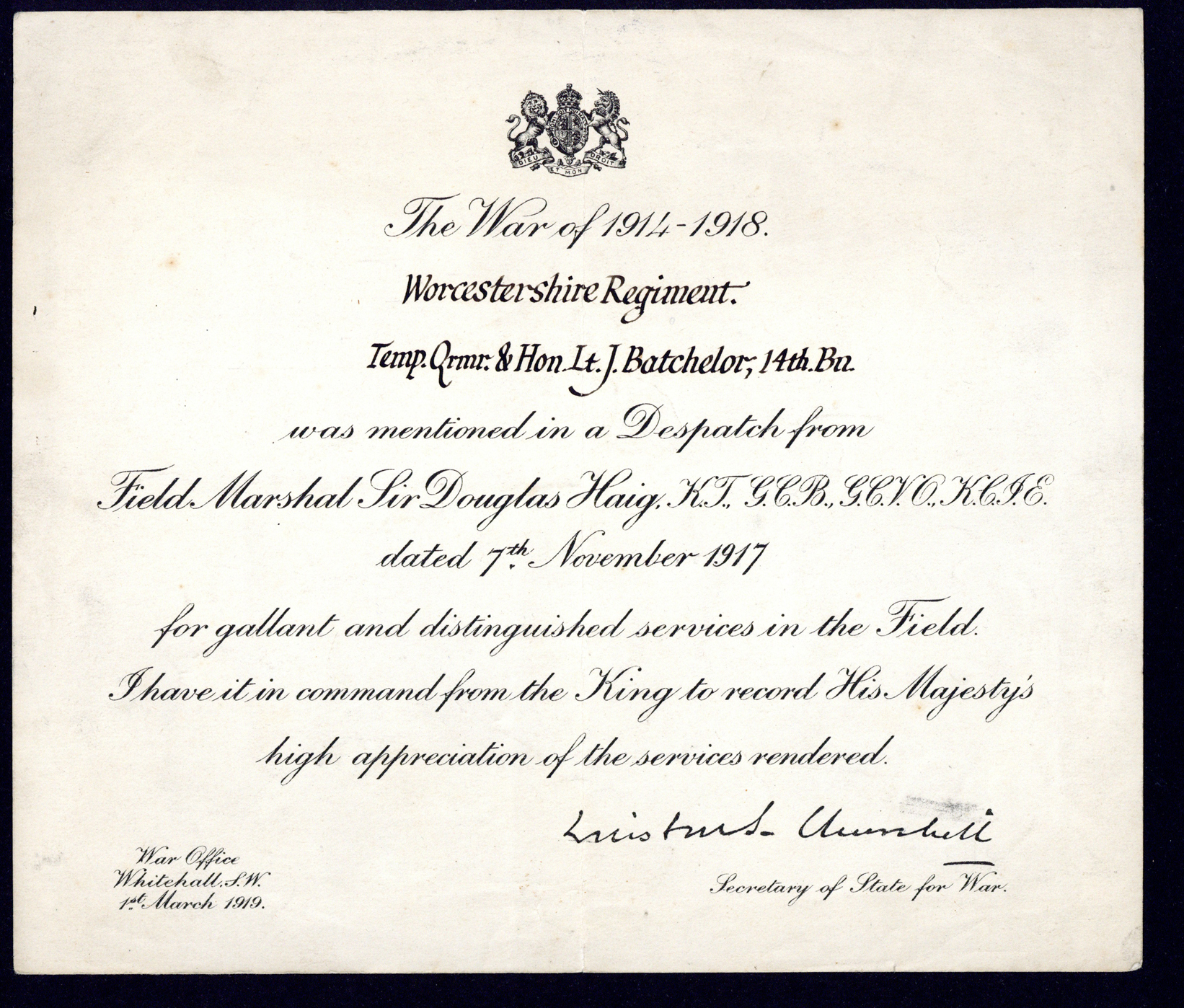
Batchelor would be, then, recognised further following the Battalion’s incessant work strengthening the trench systems and gun pits during the attacks to gain the Passchendaele Ridge. It was on the 7th of November 1917, that Batchelor received Mention in Despatches by Field Marshall Douglas Haig, appearing in the London Gazette in December 1917. The certificate received by Batchelor to inform him of this is pictured below.
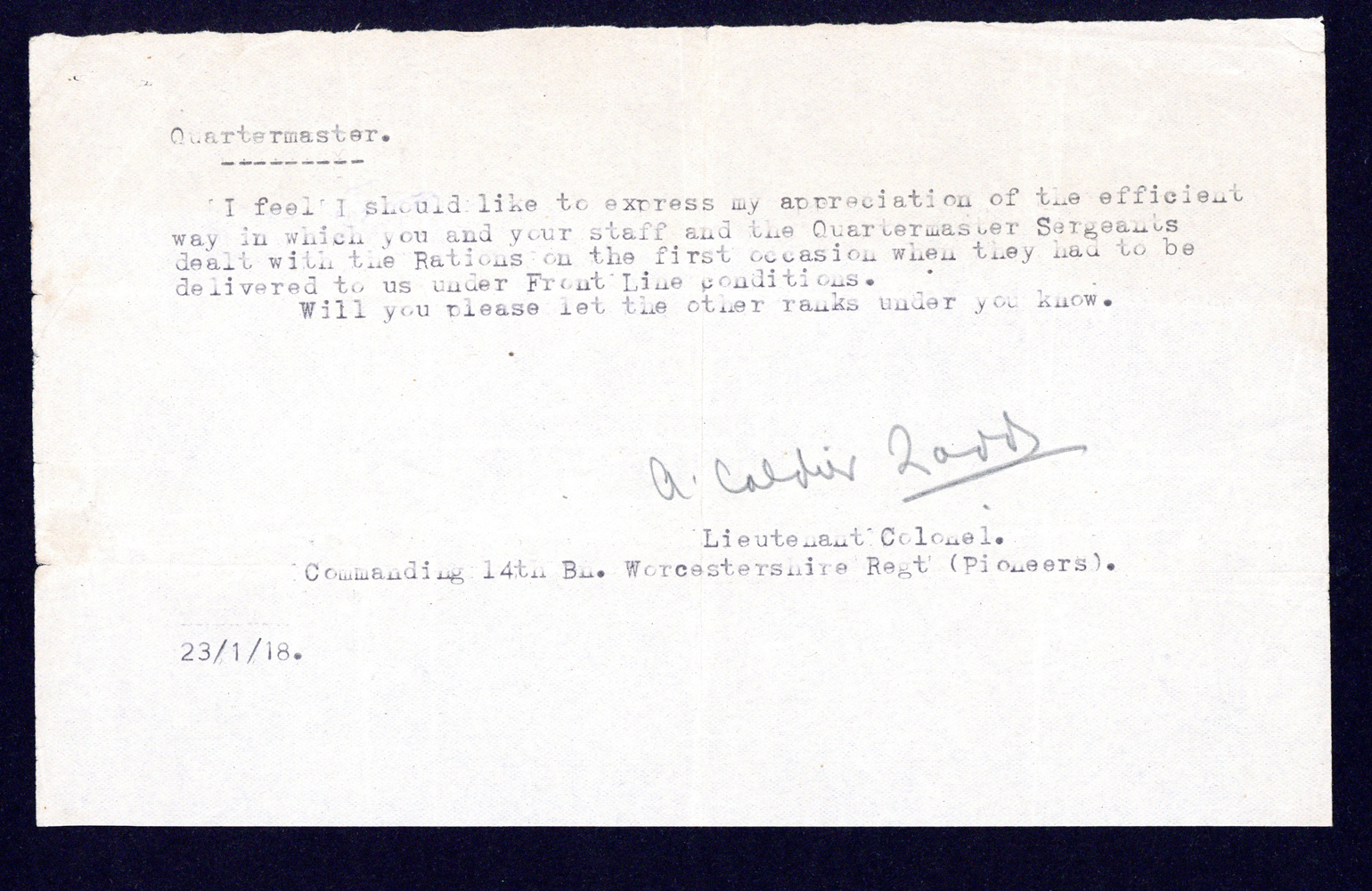
Batchelor’s prowess was further acknowledged by the C.O. of the Battalion, Lt. Col. Caldier Ladd, who, in January 1918, sent a personal letter to Batchelor, praising his efforts and urging such message to be passed on to his comrades.
Despite the end of hostilities being announced for the 11th of November 1918, the vital work of the 14th Battalion continued after this period in their labour around Mons, contributing to the reconstruction of roads, demolition, as well as the building of bridges, which proved to be incredibly appreciated efforts by the returning inhabitants through their support. On the 27th of November 1918, Captain Batchelor was granted special leave to England and rejoined the Battalion again on the 16th of December 1918.
On the 20th of March 1919, Captain Batchelor was once more allowed leave to England and returned on the 12th of April.
On the 23rd of June 1919, the remains of the 14th Battalion marched through the City of Worcester, and were met by a richly deserved welcome, having their colours hung on the Cathedral after three years on active service. This was closely followed by a Victory Parade in Worcester on the 23rd of August, consisting of upwards of 2,500 officers and men of the Regiment; this included that of Batchelor, who was one of the three officers representing the Service Battalions of the Regiment.
With the war over and duties ceased, Batchelor eventually retired at the age of 45, settling down in his home in Selly Oak, Birmingham.
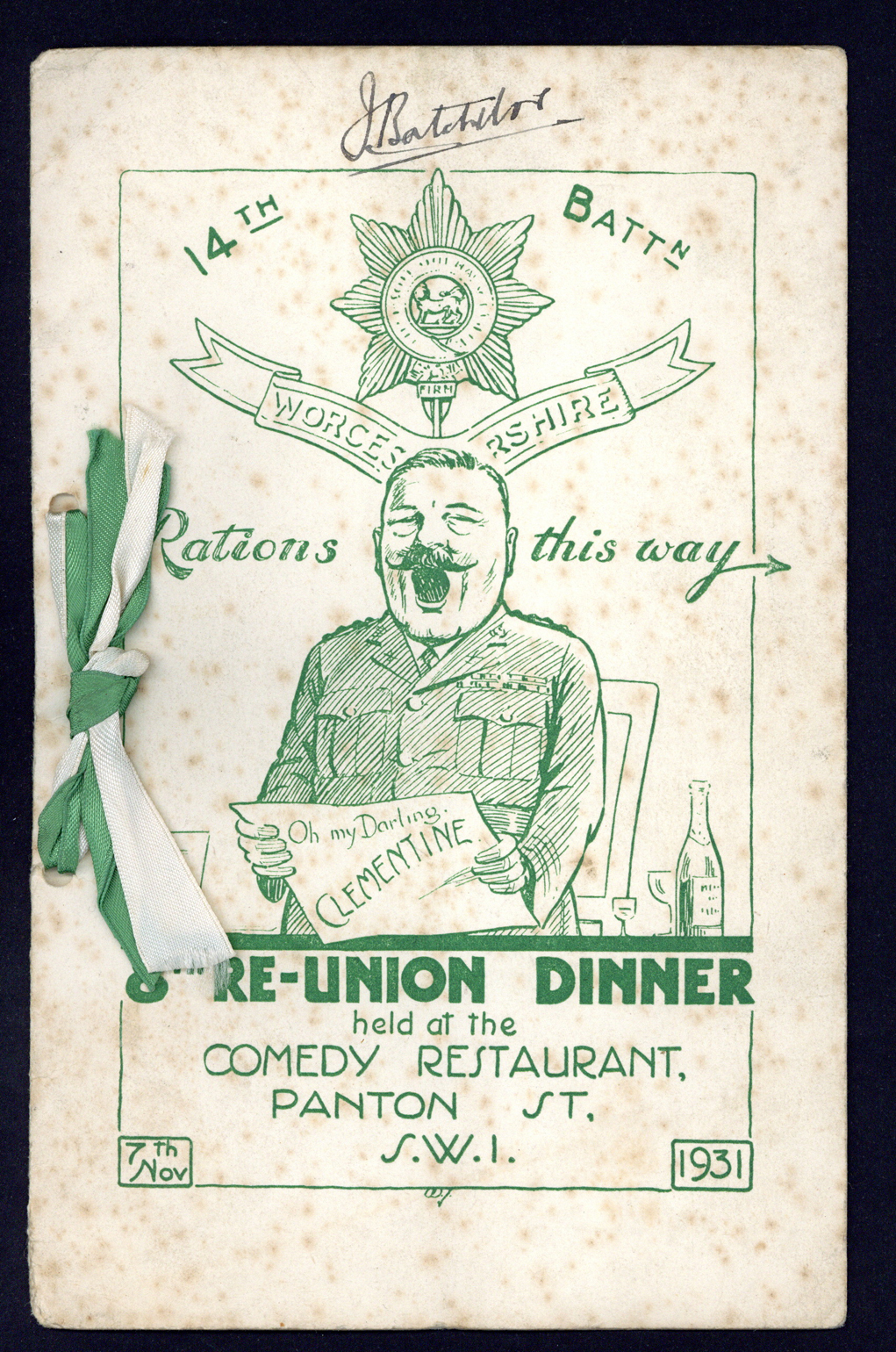
Whilst employment undertaken by Batchelor remains unknown, it is evident that he continued to take great pride in the legacy of his Battalion and his comrades as he was a regular attendee of the 14th Battalion’s annual reunion celebratory dinners. It has been recorded that James Batchelor was highly regarded as an entertainer, as each of these reunion dinners would close with Batchelor’s rendition of the song “Clementine”. On the 7th of November 1931, he was the Chairman of that year’s reunion dinner, appearing on the cover of the reunion’s booklet as well as within the lyrics of the satirical ballads of the ‘menu’ page.
Recognition of Batchelor’s expertise, dedication, and sacrifice continued after his discharge, with his receiving of the Meritorious Service Award in Army Order of 1950, at the age of 75 years old.
After nearly eight decades of continual work, James Batchelor was laid to rest on the 21st of March 1953 at 78-years-old.
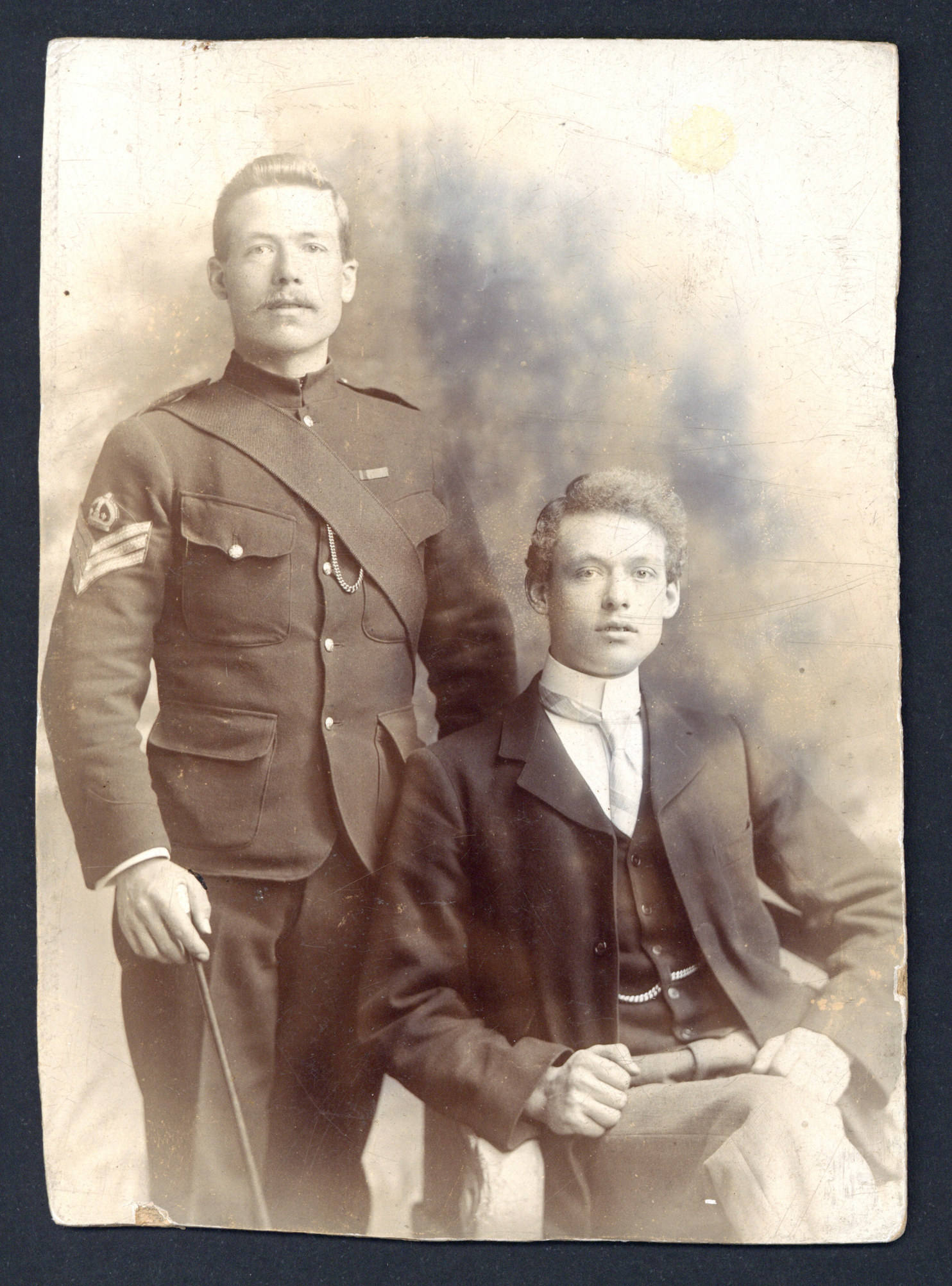
Below is an image of James Batchelor alongside his brother, Charles Batchelor, who we can observe in his uniform as Colour Sergeant.
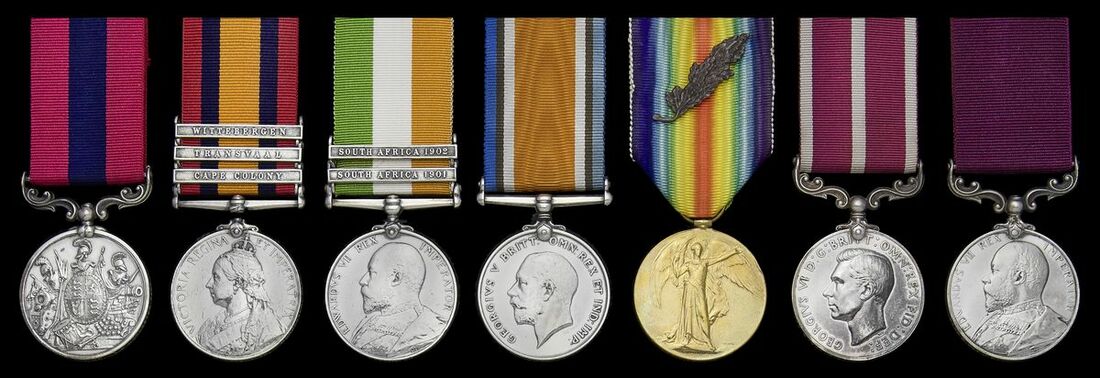
And his array of medals following his rigorous military career:
Research and article completed on behalf of the Mercian Regiment Museum (Worcestershire) by Isabelle McVeagh during trial work experience – 2026.
Credit Line
Batchelor’s medals and papers were purchased with support from the Arts Council England/V&A Purchase Grant Fund, The Worcestershire and Sherwood Foresters Regimental Association, The Mercian Regiment Regimental Heritage Fund and The Friends of the Mercian Regiment Museum (Worcestershire).
www.vam.ac.uk/purchasegrantfund
People Facet Tree