

News from the Museum: The Rawalpindi War Cemetery
Guest Article by Museum Trustee Darrell Rivers
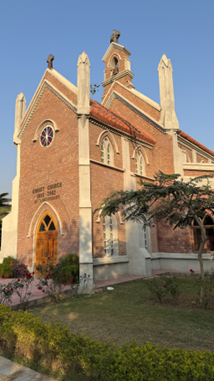
While being posted with my wife out here to Pakistan I had occasion to visit the Rawalpindi War Cemetery, just outside the Pakistani capital Islamabad. Rows and rows of clean white headstones are flanked by pristinely maintained flowers and greenery, cared for by Commonwealth War Graves. The cemetery is a consolidated section of the old ‘Gora Qabristan’ – the Christian cemetery just down the road from the 1854 Christ Church, Rawalpindi, which itself is full of storied memorials and plaques. While Islamabad is a relatively new 20th century construction, Rawalpindi is an old city with layers of history. The British Army built a cantonment in Rawalpindi in 1851, and the city came to serve an increasingly large role for the Army in the region. Many a soldier and their families spent long deployments in Rawalpindi, or the nearby summer hill station of Murree, standing ready to protect India’s Northwest Frontier or be moved on to service elsewhere in the Empire.
The graves here are all from the period of the First and Second World Wars, though this includes many largely unrelated actions along the Northwest Frontier and Afghanistan. Walking up and down the rows I saw the many different badges engraved into the marble, including some incredibly unique ones from the British Indian Army like the lateen-sailed ship of the 2nd Punjabis, or the crossed kukris of the 8th Gurkhas, but of course I was drawn towards the Garter star of the Worcestershire Regiment.
The grave read: A. Wardle – died 28 July 1941, age 20. A few minutes later my wife Thea found a second Worcester – W. A. Sanders – died 27 July 1941, age 32. At the bottom of the stone was the inscription ‘IN PROUD AND PRECIOUS MEMORY OF BILL, MOM. DAD. SISTER AND BROTHERS. Families were allowed, at their own expense, a 66-letter inscription at the bottom – the same place where the graves of unidentified soldiers are given Kipling’s famous inscription ‘Known Unto God’. It was in reading these heartfelt inscriptions that we were driven to find out more about these Worcestershire men buried so far from home. With the gracious help of Helen Hunter, we were able to acquire the full records of both soldiers.
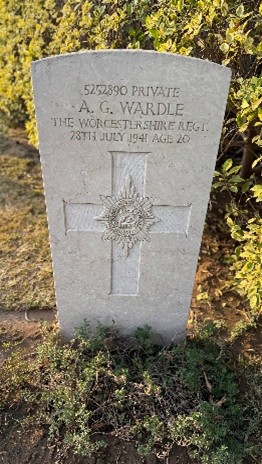
Alfred Wardle was born in Worcester in 1920 and enlisted in May of 1939 – shipping out to India in March of 1940. His record includes a long and amusing list of infractions including a 112-day detention for obscene language to a policeman. He began serving his sentence in April of 1941 and was released early in May of 1941. Only two months later he tragically died of heatstroke in the British Military Hospital Rawalpindi. On the 26th of July he was aboard a troop train from Sialkot to Rawalpindi during the hottest part of the day, at the hottest time of the year, in a particularly hot part of the country. I can attest that traveling anywhere during the day in July in the Punjab is not salubrious in the slightest. That’s when we realised that Private Sanders died the day after Private Wardle, a victim of the same overheated troop train.
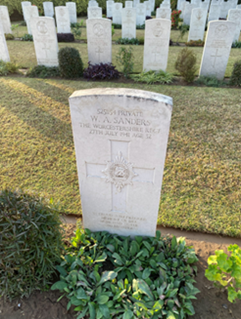
William Sanders was born in Saltley in Birmingham in 1909 and enlisted in the Worcestershire Regiment in 1934. In 1938 he served with the regiment in Palestine during the Arab Revolt of 1936-1939, earning himself the General Service Medal with Palestine Clasp, and found himself in British India by 1939. His records state that he died in hospital ‘directly due to the risks as peculiar to the circumstances of duty in military service, as he proceeded in a troops train in the hottest time of the day in weather particularly conducive to heat stroke.’ Sanders’ personal effects were returned to his family in Saltley – they included an engraved cigarette box, an Aston Villa Annual, and a Christmas carol pamphlet.
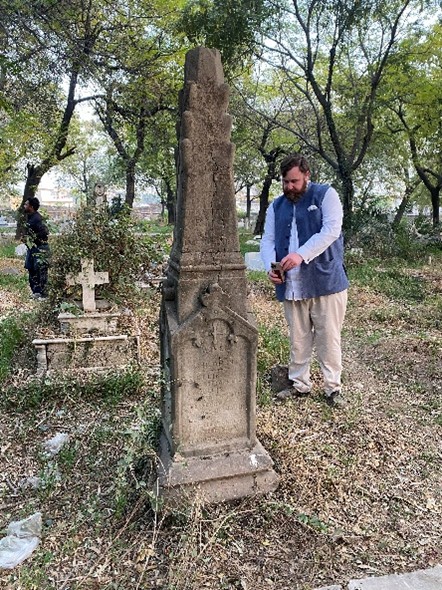
Both graves are presently kept in pristine condition by Commonwealth War Graves. Nearby memorials that precede the Great War remain in the old part of the cemetery, overgrown, with fading inscriptions lashed by torrential rains and baked by record heatwaves. These include individual graves and regimental memorials for the many hundreds of soldiers, wives, and children who died of disease and illness whilst in garrison here. The soldiers of the Worcestershire Regiment are not forgotten, even 6000km away.
People Facet Tree

One thought on “News from the Museum: The Rawalpindi War Cemetery”
Thank you Darrell, for this insight into the work of the CWGC in Rawalpindi. The research reveals that our former comrades faced many other challenges than an active enemy. We must not forget their service to King and Country so far from home.
Brest wishes
Mark