
The Home Service Dress Uniform, 1860-79
In January 1855, a new infantry headdress was introduced replacing the ‘Albert’ shako, which had been in use since 1844. The new cap of the period resembled the French infantry version with a slightly tilted front. The two-inch woollen bail tufts were two thirds white and one third red at the bottom for officers and Other Ranks of Battalion Companies. They were all green for Light Infantry Companies and all white for Grenadier Companies. The universal pattern shako plates were gilded and had black leather centres for line regiments. Other Ranks’ shako plates were brass, cast in one piece with the regimental number within the garter on a black enamelled backing. Colonels and lieutenant colonels had two bands of half inch wide gold lace around the upper part of the shako and majors had a single band of the same lace. The officers’ pattern undress cap was dark blue, with a black, oak leaf pattern, braid band. There was a black cord button with a braid figure on top and it had a narrow black leather chin strap. On the cap band was the regimental number embroidered in gold.
In 1856 the old jacket was replaced by a smarter and shorter single-breasted tunic. This was in scarlet cloth for officers, staff sergeants and sergeants and in red for the other ranks. Collars, cuffs and cuff slashes were in the facing colour ( in the case of the 29th Foot “Straw yellow” and the 36th Foot “Grass green”).
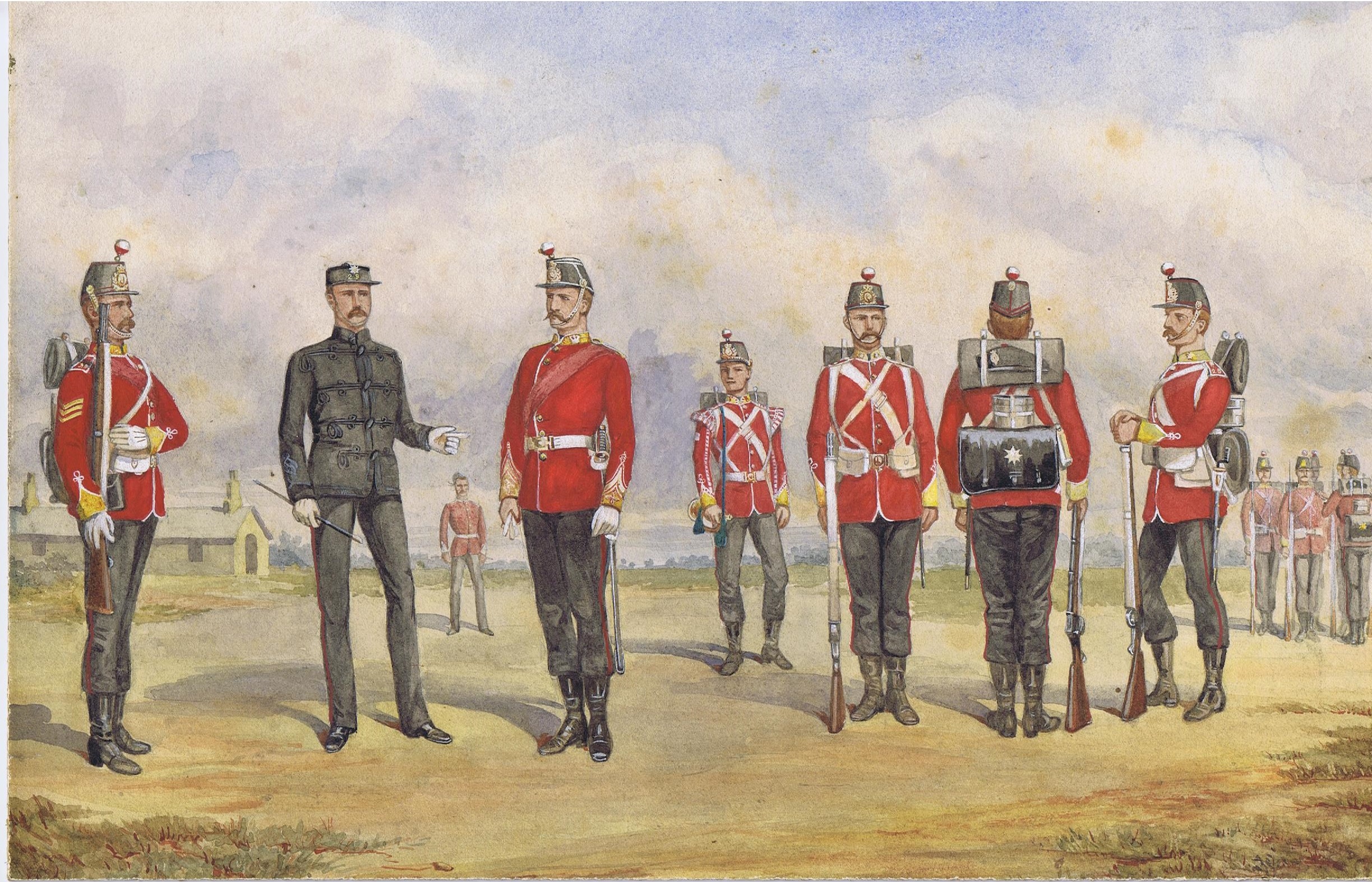
Badges of rank for officers were silver embroidery and were worn on the collar. Colonels and captains wore a crown and star; lieutenant colonels and lieutenants a crown; majors and ensigns a star. NCO’s badges of rank were worn on the right upper sleeve. Chevron bars were formed of double white worsted lace for sergeants and corporals. Gold lace was used for ranks above sergeant and the rank was worn on the right upper, or sometimes, lower sleeve. Staff sergeants and sergeants wore crimson worsted sashes over the right shoulder.
In undress, either a scarlet shell jacket or a dark blue frock were worn by officers. The shell jacket usually had ten buttons down the front, but there were regimental differences. The Other Ranks’ shell jacket was red, with facing colours, as appropriate. In summer, indigo trousers with scarlet welts were worn and in winter Oxford mixture (almost black) were taken into use. Swords were the 1822 pattern with gilded half basket hilts with the “VR” cypher set in the outward bars. The scabbards were of black leather with gilt mounts, steel for duty in the field.
Other Ranks’ equipment was the pattern approved in 1850. The waist-belt was of whitened buff leather with a brass cast locket. The seventeen-inch socket bayonet was carried in a frog on the left side. Sergeants were armed with a twenty-three inch long sword bayonet. The black leather cartridge pouch was carried on the right hip, retained by a short strap to the waist belt. It held sixty rounds and was fitted with a small pocket inside for ten percussion caps. The semi-circular mess tin in a black canvas cover was buckled to the top of the knapsack. The blanket or greatcoat was strapped to the outside of the knapsack.
Generally introduced into the army in 1871 the valise equipment replaced the old 1850 pattern. This involved considerable changes such as the knapsack being replaced by a black waterproof canvas bag or valise worn at the small of the back and supported over the shoulders by straps split into three at the level of the third button of the tunic. These straps fastened to a waist belt holding two pouches, one each side of the belt clasp, each containing twenty rounds.
Staff sergeants were armed with swords similar to the Officers’ 1822 pattern with polished brass mounts and white leather knots. Other Ranks had the thirty-nine inch barrel, three band, Enfield rifle, replaced from 1874 by the Martini Henry rifle.
People Facet Tree