

1881: Creation of The Worcestershire Regiment
The Army Reforms 1870 -1881
Edward Cardwell, Secretary of State for War between 1870 and 1874, embarked on a much-needed reform of the British army. The Crimean War (1854-6) and The Indian Mutiny (1857) had highlighted the shortcomings of the Commissariat and supply departments and demonstrated that reforms were essential. The reform of the army was made all the more urgent by the victories of the Prussian army over Austria in the Seven Weeks’ War (1866) and over the French in the Franco-Prussian War (1870-71).
Cardwell undertook the task of modernising the army through a series of measures.
This reorganised the War Office under an act of 1870:
- the various sections of the War Department were all combined in the same building;
- the Horse Guards were included under the jurisdiction of the War Office.
- The Commander-in-Chief was made subordinate to the Secretary for War.
- The Army Enlistment Act fixed the term of enlistment to 12 years, part on active service, part on reserve. Prior to this, enlistment was for ‘life’.
- The length of service overseas was limited to six years followed by six years in the reserve.
- The Martini-Henry breech-loading rifle was introduced as the main weapon of the infantry.
In 1871, the purchase of Commissions was abolished; the selection and promotion of officers was to be by merit rather than money and influence. The Purchase System of commissions had existed since the time of the Restoration, being based on usages going back to King William I. There had periodically been efforts to change the system to promotion based on merit (notably during the time of King George III) but conservatives, and those with a vested interest successfully opposed reform. Despite the howl of opposition from those who held commissions, the reform had the support of Queen Victoria. When the Regulation of the Forces Act came into effect on 1 November 1871 there were 6,938 army officers with vested rights, and these men were monetarily compensated.
In 1872, flogging in peacetime in the Royal Navy was suspended.
A year later, the regimental structure was reorganised on the basis of two ‘linked’ battalions, one serving overseas and one serving at home. Britain was divided into 69 districts, each with its own county regiment and were called by that name (for example, the York & Lancs, the Worcestershires etc.). Regiments were given a local attachment for recruitment purposes.
In April 1873 it was announced that the 22nd Brigade District was to consist of the counties of Herefordshire and Worcestershire, with a single depot for the 29th Worcestershire Regiment of Foot, the 36th Herefordshire Regiment of Foot and the Herefordshire and Worcestershire Militia. The 29th and 36th Foot were to be paired, with one regiment on active service while the other was on home duties, with the two swapping roles every few years. A depot was established at Norton barracks near Worcester.
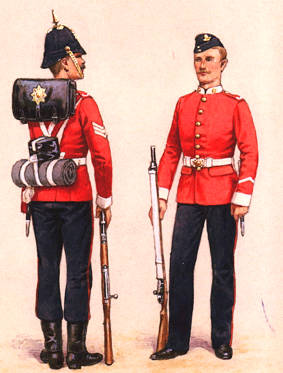
On 1 July 1881 the Childers Reforms came into effect and the 29th and 36th Regiments of Foot became the 1st and 2nd Battalions of the Worcestershire Regiment, with the militia regiments becoming the 3rd and 4th Battalions. The amalgamated regiment inherited the traditions and battle honours of the 29th and 36th Foot
People Facet Tree