
The 36th in the Ionian Islands 1820 – 1825 and 1847 – 1851
Introduction
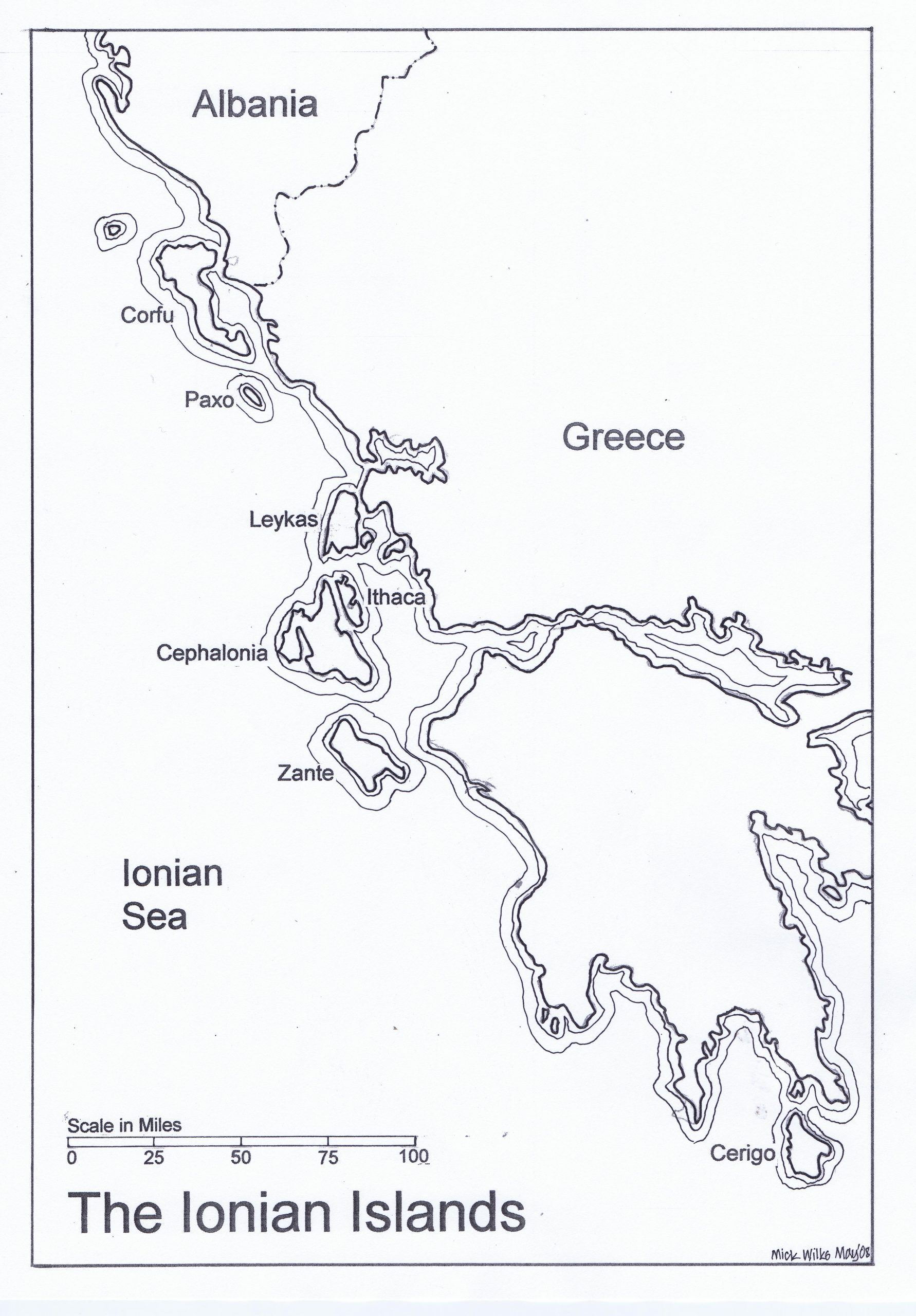
The Ionian Islands, off the west coast of Greece, consisting of Corfu, Paxo, Santa Maura, Ithaca, Cephalonia, Zante and Cerigo, had been variously controlled over the centuries by Greece, Rome, Venice, the Ottoman Empire, Russia and France but by 1815, following occupation by British forces in 1809 and the defeat of Napoleon, they became a British Protectorate and were to remain so for the next 49 years. Under the Protectorate the Seven Islands were supposedly an “independent” state administered by the British under a Lord High Commissioner appointed from London. However the nature and extent of British control, outlined in the Treaty of Paris of 1815, were left vague and the problem of maintaining “responsibility without sovereignty”, combined with the growing desire of the Ionian islanders for independence, were to cause considerable trouble in the future.
1820-25
However, when six companies of the 36th first arrived in the islands in December 1820 under the command of Lieutenant Colonel Cross, establishing their headquarters on Cephalonia in July, the greatest enemy was disease. Within five months the numbers of troops falling sick was so great that a convalescent hospital had to be established and a detachment of two subalterns, 2 sergeants and eighty rank and file, principally consisting of those most ill, were sent to Fort St George, 5 miles from Argostoli, the regimental HQ, where another hospital was established to receive them. The spread of disease was undoubtedly facilitated both by the position of the barracks on a marsh and its overcrowded accommodation. Sixteen members of the regiment died within two months causing the then Lord High Commissioner, Lieutenant General Sir Thomas Maitland to order the removal of the bulk of the regiment to Corfu in late November 1821, leaving only a small detachment on Cerigo under the command of Brevet Major William Campbell. The regiment occupied the barracks, quarters and citadel in Fort Neuf on Corfu but soon after its arrival, ill health led to Lieutenant Colonel Cross being forced to take a leave of absence and two other officers, Lieutenant Henry O’Bre and Major Henry Vernon, Commandant of Paxo, died. Major Swain, who had brought over 4 companies from Malta to Cephalonia in June 1821, was also now absent due to domestic calamities and was replaced by first Brevet Major Crosse, and then by Brevet Major Campbell in February 1822. Final command of the regiment fell to Major Edmond Browne on his arrival from England in March 1822. In June 1822 Major General Sir Frederick Adam ordered a regimental hospital to be established at the regimental HQ at Fort Neuf where, thanks to the unremitting and unwearied attention of the medical staff, as well as the dispatch of some of the sick to Malta, the regiment began to recover its strength and afterwards had the fewest sick of any regiment in the Ionian Islands or the Mediterranean. The regiment at Fort Neuf was further bolstered with the arrival on 1st February 1823 of the detachment which had been stationed at Cerigo.
Two years later, in 1825, the establishment of the regiment was augmented from 8 to 10 companies and formed into 6 service and 4 depot companies, consisting of 42 sergeants, 14 drummers and 740 rank and file. The regiment remained in the Ionian Islands until the 2nd of December 1825 when it embarked at Santa Maura for England.
1847-1851
By the time the 36th regiment came to see service again in the Ionian Islands it had been augmented in 1846 to 67 sergeants, 25 drummers and 1200 rank and file. It had also been formed into 2 battalions of 6 companies each. However not only the regiment but the situation in the Ionian Islands had changed. In 1833, after a long struggle, Greece had gained its independence from Ottoman rule and this led to rumours amongst the islanders that Britain would cede the Ionian Islands as a gesture of goodwill. However it was not an opinion shared in London and Palmerston, then Foreign Secretary, held very strong views about the strategic importance of Corfu, not least as a useful naval base in the Mediterranean. However, whatever the views of Britain, the creation of an independent Greece fundamentally altered the attitude of Ionians to their “protecting” power and led to increasing demands for constitutional reform and union with Greece. The unrest which resulted from this led to the 36th embarking once more for the islands in January 1847 in order to help maintain order.
The first battalion of the 36th under the command of Lieutenant Colonel Charles Ashmore arrived in the Ionian Islands in February 1847, the HQ and 3 companies disembarking at Argostoli in Cephalonia with 2 companies being detached to Zante and one to Ithaca. The reserve battalion under Lieutenant Colonel Charles Trollope had earlier arrived in Corfu on 31st January 1847. By the middle of May 1848 the bulk of the regiment had been moved to Corfu but it was the reserve battalion, moved from Corfu to Cephalonia on 2 August 1848 who were first to see action when on 26th September 1848 several hundred armed insurgents attacked the town of Argostoli. The attack was repelled by Sergeant Luke Dunn and twelve men of the battalion, the island’s Resident’s guard on that morning, with the loss of 2 privates killed, Daniel McNamara and William Elsom, and 2 privates wounded, Thomas Fox and James Lidwell. Several others received shots through their caps and clothing. That same day a detachment of 50 men, under Major Lorenzo Rothe, Captain James Nugent and Lieutenant Richard Lloyd, succeeded in saving the public records at Lixuri just as they were on the point of being destroyed by a party of insurgents, who fired on and wounded 2 soldiers. The detachment returned fire, wounded some of the insurgents and drove them from the town.
For the next ten or twelve nights the reserve battalion was engaged in guarding the towns of Argostoli and Lixuri during which time the sentries and guards were repeatedly fired upon and harassed by the insurgents. A party under Ensign Bernard Robert Shaw succeeded in capturing Cappoletto, one of the principal insurgents, for whose arrest a $1500 reward had been offered. Detachments of 50 men, each under Captain Alexander McGeachy Alleyne and Ensign George Massy Robins, and Lieutenant Cecil Rivers and Ensign John Edmund Harvey, were sent to the southern part of the island to scour the district of Scala where there was serious unrest.
In February 1849 two companies of the reserve battalion under Captain Charles Wilson Carden, were used to support the civil authorities at St Gerasimo in collecting fines inflicted on the villages for their part in the September 1848 insurrection and in May 1849 a company under Captain James Nugent assisted the civil authorities again in the pursuit of bandits with a company under Captain George Pratt going to Scala to assisting in the enforcement of an embargo.
On 29th August 1849 a company of the reserve battalion under Captain Henry J. Coote was detached to Sissi to help enforce martial law until late October and on 30th August 1849, and he and 2 companies of the first battalion, consisting of 4 subalterns, 5 sergeants, 2 drummers and 150 rank and file under the command of Major Edward R. King went to Cephalonia to suppress an insurrection, returning to Corfu on 17th November. During this encounter Privates Taylor and Green were wounded in a skirmish.
During September 1849 a company under Lieutenant Richard Lloyd were sent to Sissi to reinforce the detachment under Captain Coote, returning to HQ in October whilst one company under Captain Nugent went to Faraclata to assist in the pursuit of outlawed rebels. A portion of this detachment, under Ensign Alfred Macdonald, was employed as a flying column, and scoured the country in pursuit of the 3 outlawed rebel chiefs for 23 days, enduring very fatiguing marches and labour in the process. During the period of martial law from 31st August – 27th October 1849 the reserve battalion under Lieutenant Colonel Trollope was also frequently employed in pursuing groups of rebels, varying from 40 to 100 in number and in disarming rebellious villages and in guarding Argostoli, such that the men were constantly on the move and rarely slept more than one night in bed. For his efforts Trollope received the thanks of Queen Victoria and of the Legislature of the Islands and was voted a sword of honour by the inhabitants of Cephalonia.
In April 1850 the regiment was reduced to 1000 rank and file and the reserve battalion at Cephalonia was consequently broken up and consolidated with the first battalion in Corfu where the regiment was stationed throughout 1850.
In March 1851 four companies left Cephalonia for England for the purposes of forming the depot, afterwards stationed at the Isle of Wight, under the command of Lieutenant Colonel Trollope. The service companies under the command of Lieutenant Colonel Ashmore left Corfu for the West Indies the same month.
Postscript
In 1862, after failing to satisfy the Ionians demands for reform or to quell their desire for union with Greece, Britain decided to transfer the Seven Islands to Greece as a gesture of support to bolster the popularity of the new pro British King George I of Greece. The strategic and commercial worth of the islands had declined and the disadvantages of the Protectorate seemed to outweigh the advantages. On 2 May 1864 the British departed and the islands became 3 provinces of the Kingdom of Greece though Britain retained the use of the port of Corfu.
People Facet Tree